Project
ExperimentalKibitz
Chess PGN Analyzer
Paste a PGN and get a coach-level review — Stockfish finds the critical moments, OpenAI explains them in plain language.
What it is
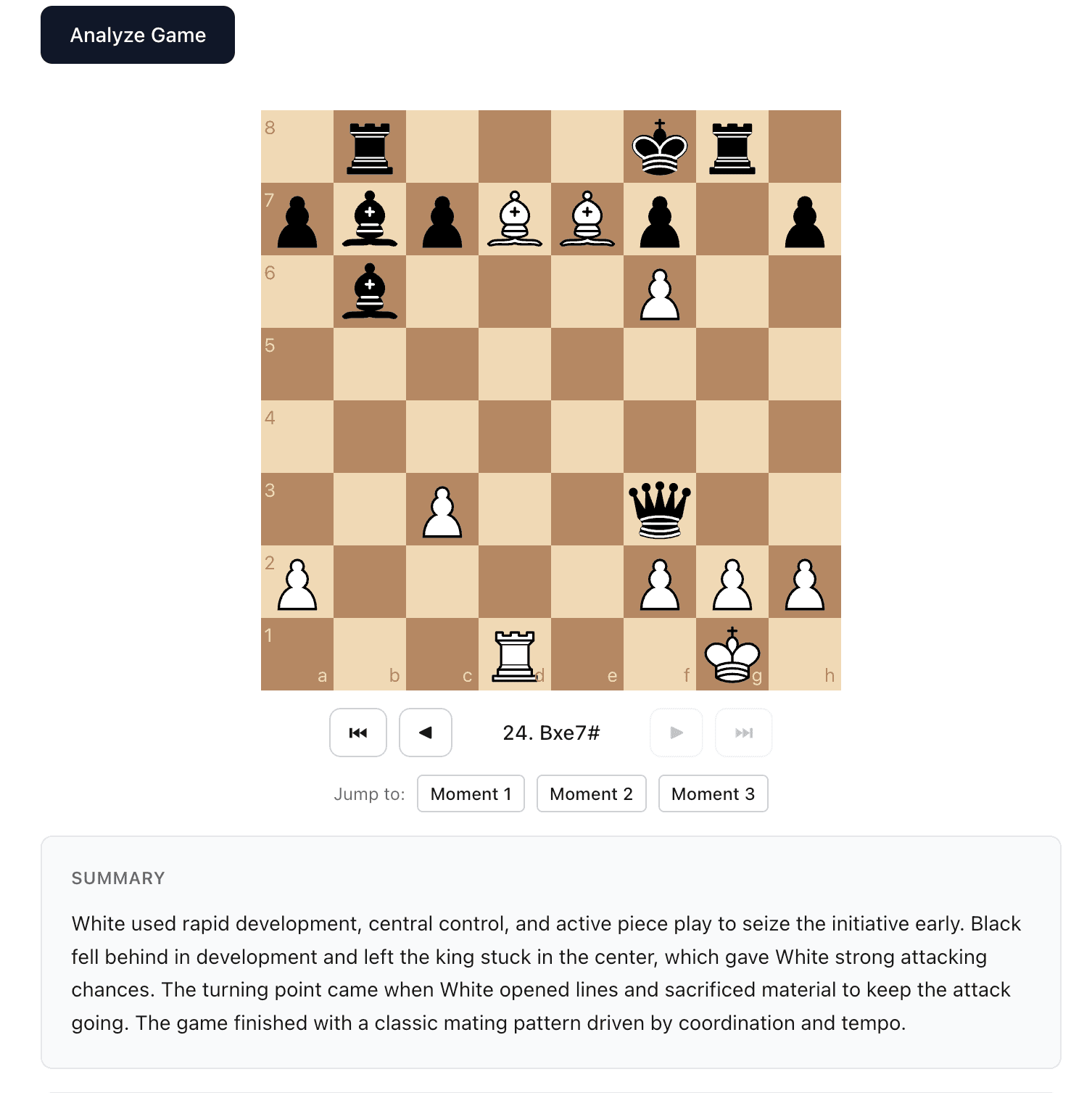
Kibitz is a game review tool for chess players who want more than a blunder count. Paste any PGN and it runs the game through Stockfish to identify the critical moments — then passes those to OpenAI, which returns coach-style explanations in plain language.
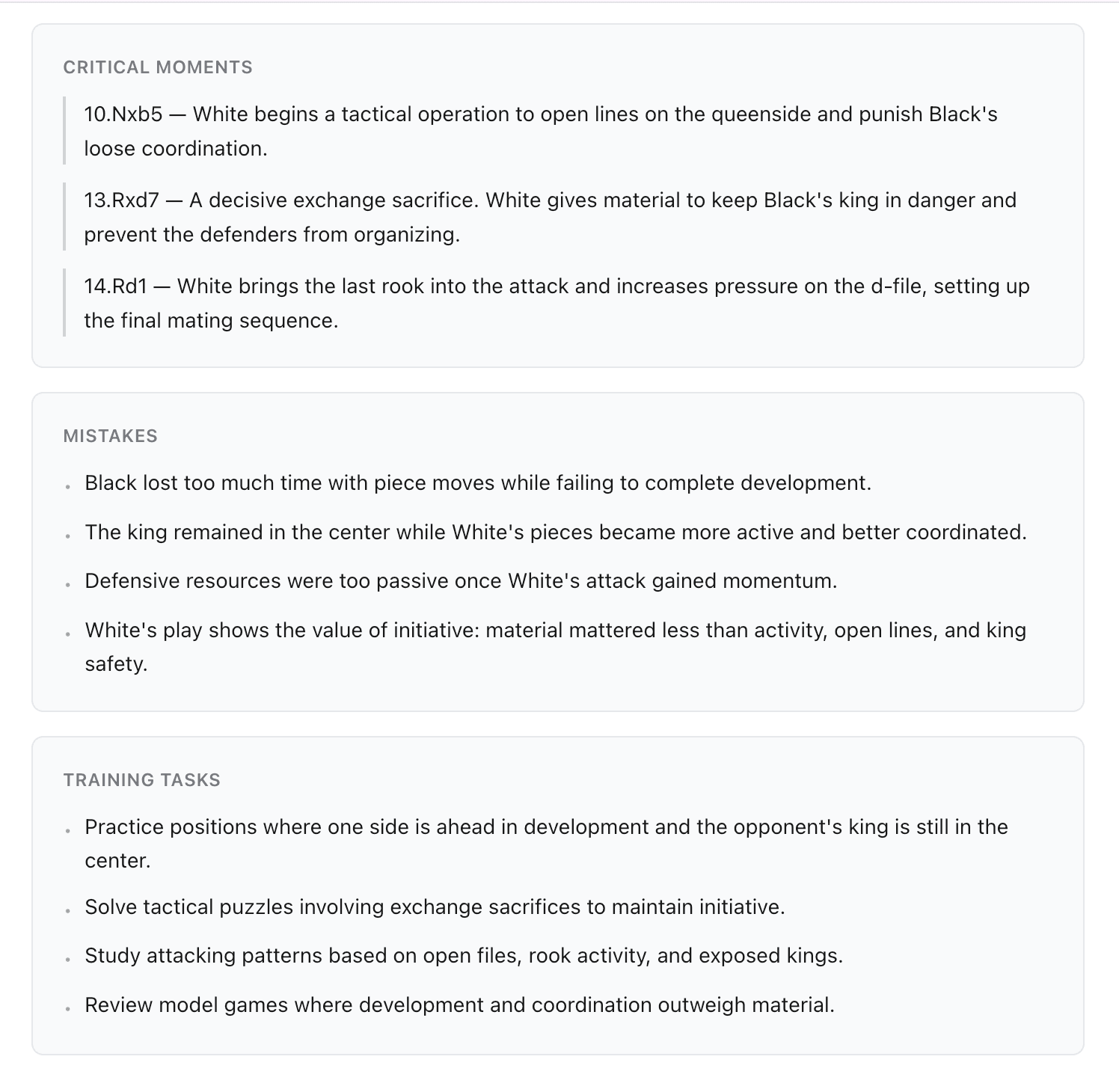
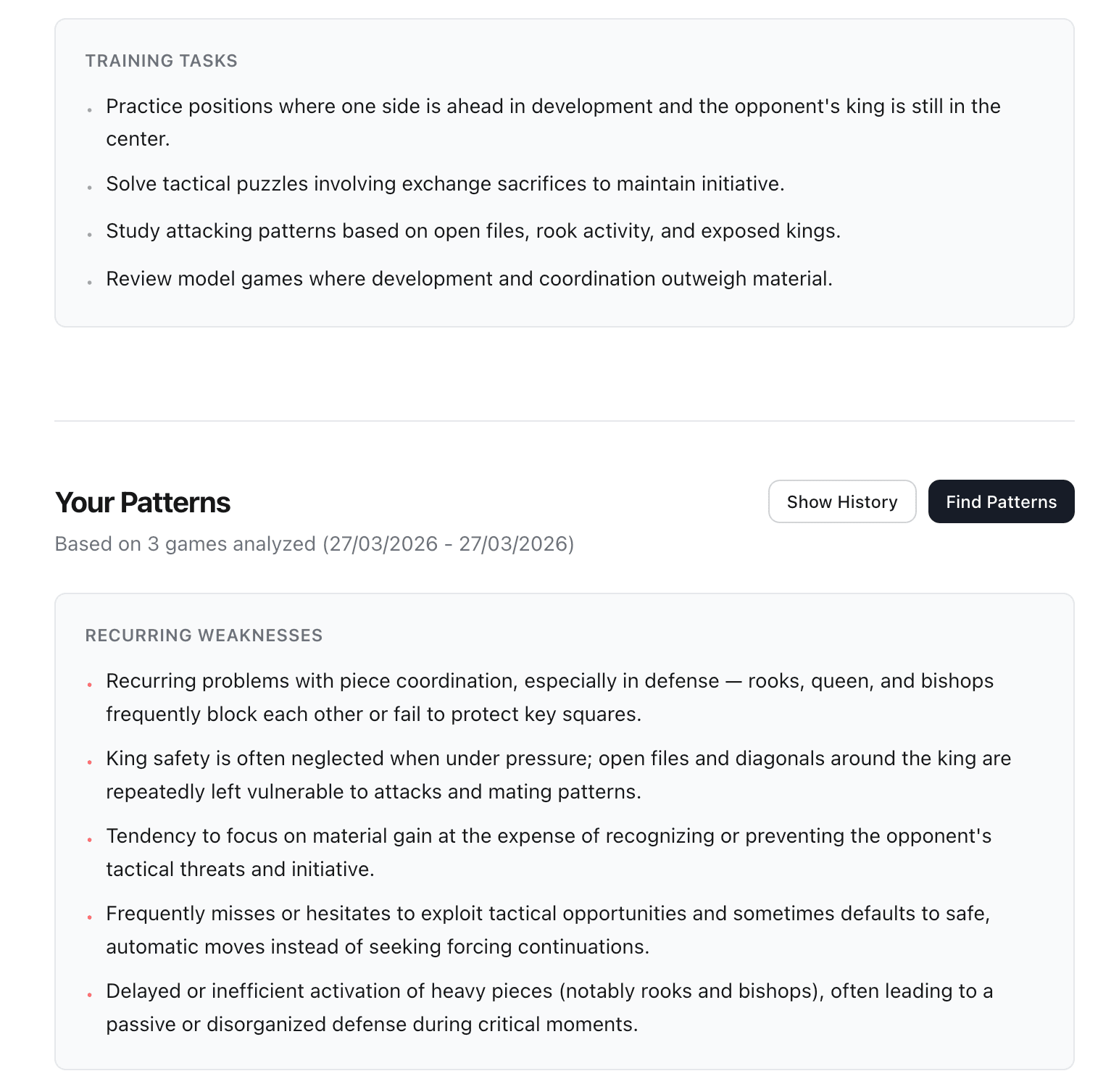
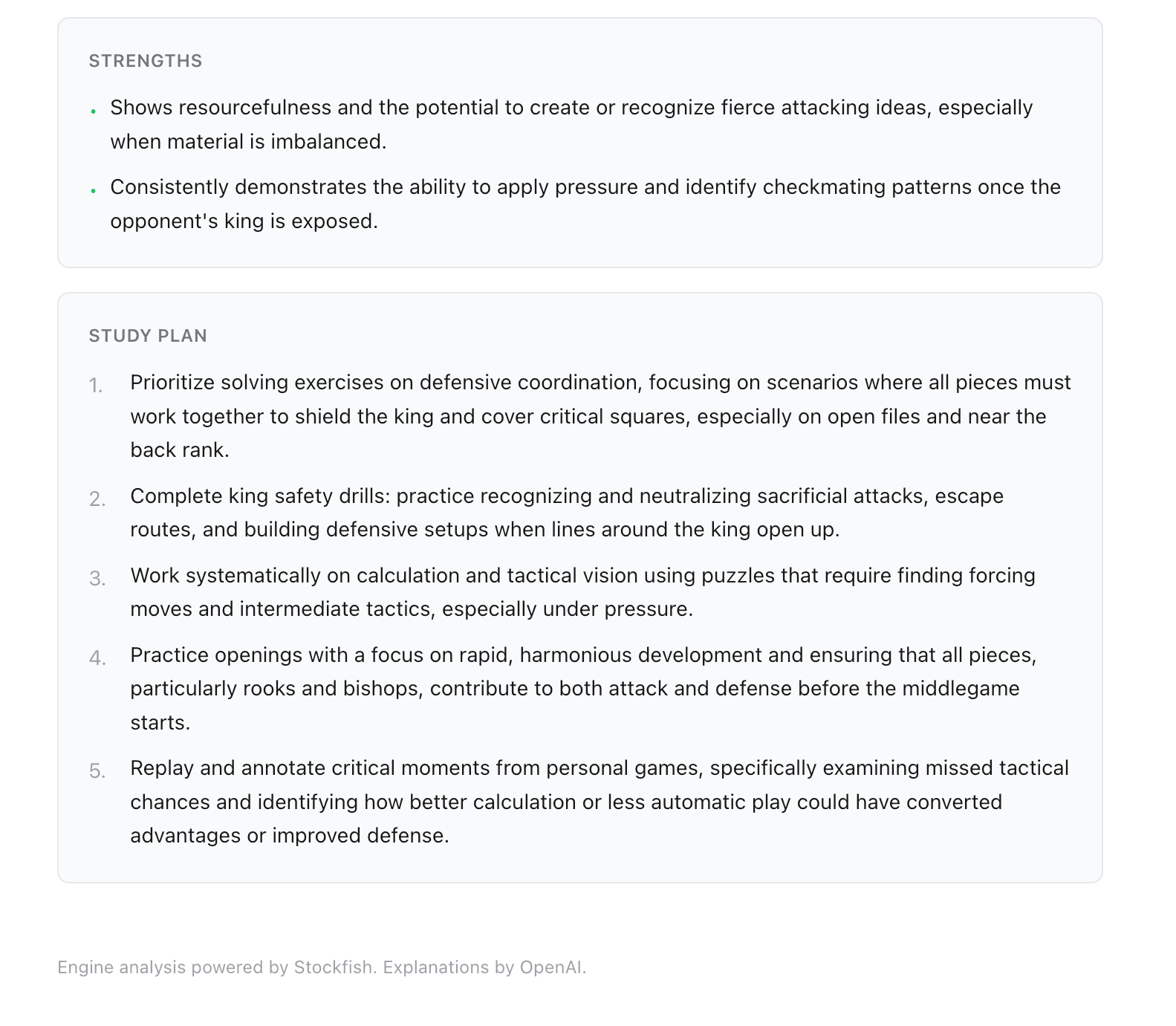
Each analysis produces a game summary, a list of critical moments with move-by-move commentary, a mistakes breakdown, and a set of targeted training tasks. Analyze multiple games and Kibitz surfaces recurring patterns: your weaknesses across games, your strengths, and a personalised study plan.
Why experimental
The project sits at the edge of what both tools do well. Stockfish is deterministic and precise; OpenAI explanations vary depending on the position's complexity. Some analyses are genuinely insightful, others more generic. Kibitz is honest about that — it's a proof of concept built to explore whether the combination is useful, not to claim it always is.
How it works
- Paste a PGN and select which side you played
- Stockfish evaluates every position and flags evaluation swings
- Critical moments are extracted and sent to OpenAI with positional context
- OpenAI returns a summary, critical moment commentary, mistakes, and training tasks
- Analyze more games and Kibitz identifies patterns across them — weaknesses, strengths, and a study plan
Stack
- Next.js and TypeScript
- Stockfish via WebAssembly for engine analysis
- OpenAI API for natural language explanations
- Tailwind CSS
Screenshots
What I learned
- The seam between systems is a design problem. Stockfish gives centipawn evaluations; OpenAI needs narrative context. I had to build an intermediate layer — board snapshots with positions, captures, and trade sequences — so the LLM had enough material to say something specific.
- Cross-game patterns are the real value. Single-game analysis is useful but forgettable. “You keep losing piece coordination after winning material” — that kind of insight only emerges across many games.
- LLM inconsistency is the real constraint. Some positions produce sharp coaching; others produce generic advice. I couldn't fully control which, and that taught me more about LLM limitations than any benchmark would have.
- Shipping imperfect work is its own skill. Building something you know is imperfect and releasing it anyway is a different discipline than building something polished.
Next steps
- Interactive board for stepping through analysis move by move
- Better positional context passed to OpenAI for more specific explanations
- User accounts to persist and revisit past analyses